
Step 0: The Basics – Emergency Readiness
Considering the processes unfolding around us, and understanding how they are interconnected, we can state with confidence that the next twenty years will be fundamentally different from the twenty we have just lived through. As uncertainty-driven change is the only certainty we can rely on, the time to prepare is now.
But prepare for what, exactly? When will these changes occur, and how severe or disruptive will they be? In truth, we are all dealing in probabilities and informed guesses. The actual outcome will only become clear when events unfold. For this reason, the single most important step we can take for ourselves and for those we care about is to establish at least a basic level of preparedness – one that gives us a realistic chance of getting through foreseeable emergencies together, and in good health.
We therefore strongly encourage you to study the following points on preparedness needs in detail. Reflect on them carefully, begin acquiring what is necessary, and plan and build systems that can sustain a liveable life even under altered conditions. Preparedness is not about stockpiling; it is about a shift in focus and mindset. It is an emotional, intellectual, and practical undertaking that requires commitment and sustained effort.
Step 1: Financial Capital – Preserving Value
On the path towards financial resilience, our next task is to examine our current situation thoroughly. How much savings do we have left after deducting our debts? With regard to our monthly income and expenditure, are we living within our means?
Prepare personal financial statements
In the business world, financial statements are the primary tools for assessing and monitoring an organisation’s stability. From these documents it is clear whether a company is solvent and whether it is operating at a profit or a loss.
The same applies to an individual or a family. We too have an equally pressing need for this level of transparency. Once it is in place, it enables us to begin defining our financial priorities.
As a first step, prepare personal versions of these two fundamental documents:
If you have never prepared either of these before, do not worry. It is not complicated. It mainly involves gathering and analysing information from bank statements, credit card statements, and other financial records. Even for those who are less disciplined, it should take no more than three to five hours, and it can be spread over several days or weeks.
Those who have already prepared such statements, or similar ones, may confidently skip ahead to the next section of this chapter.
For those to whom this is new, the next steps are as follows:
Preparing the income statement
The income statement (also known as a profit and loss statement) is essentially the financial term for a “household budget”, and it answers the following questions: how much money comes in each month, how much goes out, and how much remains (if anything at all).
Income: The money earned each month constitutes our income. If you are an employee, most – if not all – of your income will come in the form of salary or wages. If you also have investments, be sure to include forms of passive income, such as dividends from shares or rental income:
Expenses: Simply put, these are the things you spend money on. They include:
If you subtract all expenses from all income, you arrive at your monthly net profit (or loss). This is the amount of money that can be used to increase your financial capital – or not.
Knowing this figure allows you to begin addressing fundamental financial questions, such as:
The insight this exercise provides into the actual state of a household’s cash flow is often sobering. It brings to light areas of overspending that may previously have gone unnoticed. This is, in fact, good news, as it enables us to make rational decisions about non-essential expenses that we may be able to cut back on – thereby creating “unexpected income” that can be redirected to other areas of life that matter more to us.
This brings us to the next task:
Preparing the balance sheet
The balance sheet is a snapshot of your net financial wealth. It answers the question: How much money do I have?
The term net is significant here. It reflects your wealth after any liabilities have been taken into account – in other words, your assets reduced by your debts.
Your personal balance sheet therefore includes both assets (things you own that have value) and liabilities (your debts). The difference between the two is your net financial wealth.
This is the point at which you need to focus on identifying and tracking all of your assets and liabilities.
Assets may include:
Liabilities may include:
Once you have gathered all the information in one place, calculating your total assets and liabilities is straightforward. As noted, subtracting total liabilities from total assets gives you the value of your net financial wealth – that is, the amount of financial wealth you own “free and clear”.
Naturally, most of us hope this figure will be positive and as large as possible. Whatever the number turns out to be, however, it represents what we actually have – at least for now.
Whatever net worth figure you arrive at, you now have accurate data that can inform decisions about your next steps.
Although everyone’s financial situation is unique, this insight enables us to give considered answers to important questions such as:
Action
Your personal financial statements are now complete, and you have a clear understanding of how well positioned you are to achieve your financial goals. The next step is to develop a plan aimed at reaching those goals.
Ideally, this should be done with the guidance of a financial adviser who has extensive experience in providing this type of support and who understands the risks we are likely to face in the uncertain years ahead.
Whether you choose to work with an adviser or undertake this task independently, you should create a personalised plan based on your financial statements. This plan should clearly define, within your means, how much you spend on living your life now (the present), how much and in what you invest to prepare effectively for an uncertain future, and in what form and instruments you hold your wealth – taking into account that it should remain a usable store of value even under changing conditions.
Do not forget, however, that money is merely a tool for achieving your goals, and that financial capital is only one of the eight forms of capital which together constitute true wealth. Do not allow money to determine your happiness. Remember: contentment is the foundation of happiness.
Step 2: Living Capital – A Healthy Body and Mind
Health
This is always, under all circumstances, the most important asset we can possess. Even in today’s relatively peaceful conditions – and especially in a world where access to healthcare and medicines may become extremely difficult – health becomes invaluable. Whatever challenges we may face, those who must endure them while unwell will find life even harder than it already is.
One of the most important things we can do is to acquire knowledge and learn appropriate behaviours. Awareness and lifestyle change can play a decisive role in preparing for changing circumstances.
Nutrition
Nothing has a greater impact on our overall health and physical condition than what we put into our bodies. You are what you eat. For this reason, nutrition deserves the greatest emphasis. Whether your goal is weight loss, feeling better, improving performance, or becoming healthier, diet is a key factor.
Many things we consume almost out of habit are actively harmful to the body. Poor nutrition not only makes us feel unwell, but can also lead to inflammatory and degenerative processes and accelerate ageing.
In short, aim to eat whole foods: meat and vegetables, nuts and seeds, some fruit, little starch, and almost no sugar.
There is an enormous body of literature on nutrition today. It is worth learning about the Paleo, Primal, and Zone diets. It is certainly advisable to consult a professional nutritionist to discuss your personal health situation and goals.
Exercise
Regular physical activity has a fundamentally positive effect on health. Fitness programmes focusing on relatively high-intensity functional movement are particularly recommended – especially when combined with a personalised nutrition plan and a strong, supportive community.
If you are just starting out, consider trying CrossFit-style training centres that offer “boot camp” classes. This type of exercise develops several core athletic skills simultaneously, such as strength, endurance, speed, accuracy, and coordination.
Sleep
Sleep quality is one of the most fundamental – yet most neglected and undervalued – conditions for good health.
Adequate sleep offers many benefits, while insufficient sleep can lead to chronic fatigue, poor concentration, weight gain, and an increased risk of diabetes and heart attack. Unfortunately, chronic sleep problems are widespread. Our overstretched pace of life often reduces sleep duration, while digital devices impair sleep quality. Make a conscious effort to improve your sleep. Bring your average bedtime forward by one to two hours, and avoid using phones, computers, or televisions for at least an hour before going to bed. Even earlier, switch screens to night mode to reduce the disruptive effects of electronic light. You may notice a significant difference within just a few days.
Stress management
It is scientifically proven that chronic stress harms the body. But how can we reduce it? This topic is discussed in more detail in the chapter on mental health, but the key message is to identify the areas of greatest imbalance and tension in your life, then determine the steps needed to restore harmony. These may be small changes, exercise, spiritual practices, faith-based activities, or even major decisions such as changing jobs.
Eye care and dentistry
Eye and dental problems can represent serious vulnerabilities in difficult times, when we may need these faculties the most but access to medical care becomes limited.
For vision problems, laser eye surgery may be a good corrective option. While not inexpensive, clear vision and independence from glasses or contact lenses can be extremely valuable. Over the long term, their ongoing costs may be higher, and reliance on them poses greater risk.
Similarly, dental problems tend to worsen with age, and the longer they remain untreated, the more complex, costly, and time-consuming they become. Invest time and money in resolving them while dental care systems are still functioning reliably.
Nature
Beyond our own health, we also depend on the health of the living systems around us. These deserve the same care and attention as our own bodies. Protect and nurture the natural environment around you.
Expanding local food sources
Once you have stored some food, the next step is to expand your local sources of supply. The more people buy food directly from local producers, the more viable food production becomes for them – and we also gain access to high-quality produce.
Supporting community-supported agriculture schemes – where you purchase a share of a farm’s seasonal output – means gaining healthier, tastier food while increasing demand for local produce and supporting local communities. If you are not yet part of such a scheme and have the opportunity, consider joining one. Alternatively, build relationships with local farmers and food producers and, where possible, buy directly from them.
Gardening
Ideally, you should be able to produce at least part of your own food. If you ever face circumstances where your survival depends on your ability to grow food, the difference between having “some” experience and having “none” will be immense.
Local garden centres can supply almost everything you need and often provide guidance as well. Where possible, buy tools and starter seed kits locally, and store a reserve supply of seeds sufficient for a full vegetable garden.
There are many excellent books and resources on home gardening. Taking the time to read and discuss plans with more experienced gardeners can save considerable time by avoiding common beginner mistakes. Raised beds are often a favourable option. Gardening largely involves experimentation, trial and error, and learning how nature works.
Food preparation and storage
Root cellars or underground storage pits can be effective for long-term storage of root vegetables such as potatoes, beetroot, parsnips, and carrots. This method requires learning and experimentation, particularly regarding suitable varieties, temperature, and humidity control.
Keeping chickens is also an efficient way of producing food: you gain a steady supply of fresh eggs, while the birds convert kitchen waste into eggs and fertiliser.
Fermentation and preserving are also important areas. In addition to making preserves or canned foods – which require a significant learning process – much food can be dehydrated.
Dehydration preserves more nutrients and requires far less storage space. Dried foods can be stored for exceptionally long periods, as most bacteria are destroyed or rendered inactive during drying.
Food can be dehydrated naturally, for example using drying racks, or with purpose-built, higher-capacity dehydrators, allowing meat, vegetables, and fruit to be preserved.
Each of these practices creates a closer connection to our food and requires different skills and knowledge. Wherever you live, it is important to understand the specific conditions required for successful cultivation and which crops grow particularly well in your area. Start by adapting your eating habits and expectations to foods that are easy to grow and source locally.
A worthwhile goal is to produce as much food as possible where you live, using as little personal energy as possible. Whether or not you can grow your own food, work out how to source as much food locally as possible during its season, and then learn how to store it so it lasts as long as possible.
Step 3: Material Capital – A Secure Home and Environment
Physical assets are the tangible “things” that are of practical use to us. These include our property, our businesses, and the tools and equipment we use.
Energy
Energy is the foundation of everything. Without it, we would live cold, dark, and impoverished lives.
It is therefore essential to learn how to use what we have as efficiently as possible. Immediately after this comes exploring how we can produce part of the energy we use ourselves. The difference between being able to generate 5–10% of your own energy and generating 0% may prove critical.
Water
Beyond basic emergency water storage guidelines, we recommend that, if space and circumstances allow, you consider larger-scale water collection solutions. One of the simplest and most effective options is a rainwater harvesting system. By combining rainwater collection with a drilled well, it is possible to become largely independent of the municipal water supply.
For those who rely on well water, it is extremely important to have a manual back-up system in case the automatic pump fails or stops due to a power cut.
Tools
Having knowledge is only part of the solution; the right tools are also required. Make a list of the tools you may need in a wide range of situations. As many tools are not used on a daily basis (such as chainsaws or log splitters), it can be highly beneficial to establish a “neighbourhood tool-sharing scheme”. This involves sharing the cost of tools that are used occasionally or infrequently and making them available for joint use when needed, or creating a system where collectively purchased tools are accessible to everyone involved.
Home security
After investing significant time and energy in developing your physical assets, it is important to keep them secure – that is, protected from unauthorised access, while still remaining available to you when needed. The next step, therefore, is to ensure the security of your home.
Step 4: Knowledge Capital – Practical Skills and Understanding
“Knowledge capital” encompasses all the knowledge you have acquired and are able to apply, and convert into real value – value that can be exchanged for income or for the goods and services necessary for life.
Our current education system does not truly prepare us, either theoretically or practically, to become self-sufficient across multiple areas of life under changing conditions.
For this reason, consider carefully which knowledge you can reliably draw upon, what is relatively easily accessible within your environment (for example, because a neighbour or family member possesses it), and what is less accessible yet may be essential for you.
Based on this, decide the order of priority in which you will begin acquiring knowledge, learning new skills, and determining how you will integrate them into your life.
It is worth researching thoroughly, as an increasing number of courses, educational films, books, and online knowledge-sharing platforms are available to support learning. Local self-education groups exist, self-sufficient farms organise study visits and open days, and many other opportunities are waiting to be explored.
What might these specific areas be? Here are some suggestions:
And so on.
Step 5: Emotional Capital – Building Stress Resilience
Research based on people who have survived disasters – whether personal, social, or natural – shows that the most important form of preparedness is, in fact, mental and emotional readiness. Numerous examples demonstrate that people with almost nothing can survive successfully – often with nothing at all, relying solely on the right mindset. At the same time, many cases show that individuals who possess almost every material requirement can collapse within moments once they lose emotional stability and, with it, sound judgement.
In other words, even if we have adequate reserves and self-defence capabilities, without a strong mental and emotional foundation – and the objective thinking that accompanies it – all physical preparedness can become meaningless.
Humans are inherently social beings. We are designed to live in community with others. The “lone wolf” who lives in isolation cannot rely on the support of others. After catastrophic events, people with communities, friends, and family are more likely to survive and to remain in relatively good condition. It is a proven fact that human groups are more effective than individuals in locating resources, dividing labour, and defending themselves against external threats.
Developing emotional resilience
Focus on what is at least partly within our control: shaping events in ways that are more favourable for ourselves and our loved ones. Many believe that psychological trauma is an inevitable consequence of experiencing a disaster. Research shows, however, that the most common response to major disasters is the development of stress tolerance – also known as resilience. Most people are capable of coping with adversity without external help.
We now understand the characteristics of people who tolerate stress well and remain adaptable. Developing emotional resilience largely depends on incorporating as many of these “protective factors” as possible into our own lives and those of our loved ones. Some of these include:
Play and enjoyment: consciously choose games and leisure activities – especially social ones – that distract, relax, and replenish you, reduce stress, challenge the mind (for example, puzzles), and strengthen social bonds. In short, they help us to truly live life.
Step 6: Social Capital – Creating a Supportive Community
We are entering a period that will make our previous lives seem like a time of carefree peace. We will need one another to an extent not experienced for generations. People inherently long for community. In a world where social interaction is mediated by technology and communities have become fragmented, people feel more isolated than ever before. Technology certainly has a role in organisation and communication, but real solutions will be found and implemented through personal interaction and people working side by side.
We have invested enormous amounts of time and money in creating isolated personal worlds around ourselves. Comparable effort will be required to build communities that are resilient enough to cope with the difficult years ahead.
Creating communities is both easier and harder than we might think.
Experience shows that the greatest obstacle to building a community is the amount of time required – not only from oneself, but from others who are meant to form that community. It does not matter if I can dedicate ten hours a week if others can only spare two hours every second Sunday afternoon. Of course, a community can still be built between three and five o’clock every other Sunday – it will simply take longer. The real question is: how much time do we actually have left to act meaningfully for ourselves and for one another? If supply chains break down or inflation spirals out of control and food prices increase tenfold, very few people will still have the capacity to organise community learning events on long-term food storage.
“Community” is not the same as “friends”.
Not everyone I want in my community network will be someone I am, or will become, friends with. In an ideal world, we would be close friends with the electrician, the local farmer, the doctor, the dentist, the shopkeeper, and so on. But do not delay action simply because friendship does not develop. Do not expect to be close friends with everyone in the community. If they are capable, skilled, and reliable, that is already ideal. Friendship is an added benefit.
Start small. If only a few people attend the first community gathering, that is perfectly fine. Never be discouraged by how insignificant the first steps may seem. These are merely building blocks towards a much larger goal.
Start now. The longer you do it, the more it will feel as though you have only just begun – and that is a good thing. With each step, you and your peers will grow stronger.
Be patient. Community-building cannot be rushed. People open up at their own pace, and genuine trust takes time to develop.
Finally, accept what people offer, no matter how small. You never know where it may lead. The reverse is doubly true.
Additional ideas to consider:
And so on.
Step 7: Cultural Capital – Understanding Human Responses
This form of capital is perhaps the least within our direct control.
Moving to a better place
Many people dream of moving to another country where better resources, infrastructure, and communities are available. This can be very appealing. However, such a decision should not be taken lightly. Many factors must be considered, including the very real possibility that, as a newcomer, you may always be regarded as an “outsider” by locals, regardless of how long you live there or how committed you are to becoming part of the community.
If you are considering relocation, thorough research in advance is essential.
One key factor is population density. If you have the opportunity to move to a sparsely populated region, this can be highly advantageous. Regardless of whether a crisis is man-made or natural, living in a low-density area generally means fewer problems – for example, a lower likelihood of large-scale unrest.
Another important consideration when choosing a property is the local economy. A diverse local economy, particularly one with a strong agricultural base, is preferable. Abundant water resources are critical, ideally in areas where hydropower predominates, as this is among the most predictable and reliable energy sources. It is also worth investigating whether the regional electricity supply can be isolated in an emergency – that is, whether the area could be powered locally if disconnected from the central grid.
Ideally, the most favourable place to settle is a sparsely populated agricultural area with plentiful water – preferably with easy access to well water, or even better, spring water that flows to the house by gravity – and located in an energy-exporting region. These are likely to be among the safest places if society were to collapse. By contrast, large cities and the routes leading out of them are unlikely to remain safe.
Be present in the process of adaptation
You must live in your future refuge for most of the year and adopt a self-sufficient lifestyle. Survival skills cannot simply be “bought”; everything has a learning curve. You may purchase a wood-burning stove, but that does not mean you know how to use it. Gardening is the same: it takes years for soil to develop, for orchards and vegetable gardens to mature, and trees take even longer.
You must be there, living locally. You need to understand the characteristics of the local climate and learn which plants thrive in that environment. All of this requires time and effort. If it does not become part of your daily life, you cannot expect everything to function smoothly at the last moment – because it almost certainly will not, at least not as you imagine or hope.
At the same time, while rural areas tend to have low population density, neighbours often know one another well. Your survival will therefore depend on friends and neighbours you can trust. Going it alone is unlikely to succeed. A community can be small – even just two or three neighbours – but it is still a community if it is functional and supportive. You will need people you can genuinely rely on.
Step 8: Time Capital – Using the Most Valuable Resource Wisely
How will I have enough time for everything?
The list of tasks ahead is almost endless. At the same time, everyone has a life to live, and most people cannot afford to devote all their time to building resilience from tomorrow onwards.
The first step is to recognise that this is a process. No one – not even the most determined and disciplined – will ever be fully prepared. Do not strive for that. Instead, focus your time and attention on the areas where you feel most vulnerable, or which interest you the most. Then simply start taking action. Small steps are perfectly acceptable. What matters is that you begin moving forward towards your goal.
One useful tool is the Influence and Action matrix.
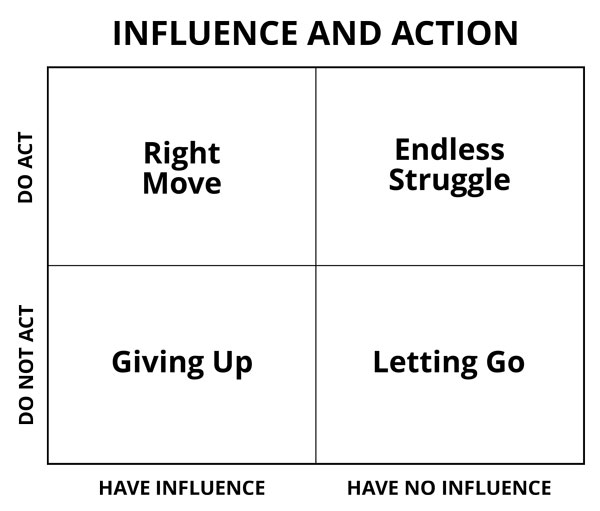
Tasks become clearer when we place them into the four quadrants of the matrix, based on how much influence and ability to act we have over them:
What can I influence and requires immediate action?
What can I not influence at all, and therefore must let go?
And what lies in between – where I may have some influence but choose not to act yet, or where I recognise that no matter how hard I try, I have very limited control?
What next?
Once this is done, focus your energy on tasks where you can take the first right step today. Do not waste time on those that will only lead to constant struggle. Set aside, with a clear conscience, the tasks you have assigned to letting go. Tasks related to giving up can be revisited later if circumstances change and you feel you may have a better chance of making progress.
Our modern habits often work against efficiency. Digital devices, meetings, and countless distractions fragment our attention, making focus and effectiveness difficult. In many cases, less is more: do fewer things, but do them well. Many issues resolve themselves over time.
Carry out your tasks to the best of your ability, but be satisfied with your results, however small they may be.
When people reach this level of understanding and begin preparing, many are overwhelmed by a panicked sense of urgency – that there is no longer enough time before the system collapses. A paralysing fear sets in that they have done too little and started too late.
In reality, there is always time to do something – anything. And that is vastly better than doing nothing. Instead of fear, we encourage everyone to take a deep breath, be kind to themselves, and focus simply on taking the next step.
The sense of gratitude
None of us can know what will ultimately push us to the next stage – when most people finally realise that if there ever was such a thing as “normal”, we are unlikely to return to it anytime soon, if ever. Perhaps a pandemic, or a war unfolding nearby, will be the catalyst.
This present moment may be a gift of time – one that may last a little longer – allowing us to adapt to a new reality that we will each create in our own lives. Some are further along than others; many have not yet reflected on what may lie ahead. Yet all of us have the capacity to understand intellectually and emotionally the processes around us, their direction, and their likely consequences for our lives.
Because we cannot know what will happen, or when, one of the most effective life strategies may be to do things we love – things that also strengthen our own resilience and that of our communities, while bringing our thoughts and actions into alignment.
Feel gratitude for everything that has been given so far, and for what still lies ahead.
Considering the processes unfolding around us, and understanding how they are interconnected, we can state with confidence that the next twenty years will be fundamentally different from the twenty we have just lived through. As uncertainty-driven change is the only certainty we can rely on, the time to prepare is now.
But prepare for what, exactly? When will these changes occur, and how severe or disruptive will they be? In truth, we are all dealing in probabilities and informed guesses. The actual outcome will only become clear when events unfold. For this reason, the single most important step we can take for ourselves and for those we care about is to establish at least a basic level of preparedness – one that gives us a realistic chance of getting through foreseeable emergencies together, and in good health.
We therefore strongly encourage you to study the following points on preparedness needs in detail. Reflect on them carefully, begin acquiring what is necessary, and plan and build systems that can sustain a liveable life even under altered conditions. Preparedness is not about stockpiling; it is about a shift in focus and mindset. It is an emotional, intellectual, and practical undertaking that requires commitment and sustained effort.
On the path towards financial resilience, our next task is to examine our current situation thoroughly. How much savings do we have left after deducting our debts? With regard to our monthly income and expenditure, are we living within our means?
Prepare personal financial statements
In the business world, financial statements are the primary tools for assessing and monitoring an organisation’s stability. From these documents it is clear whether a company is solvent and whether it is operating at a profit or a loss.
The same applies to an individual or a family. We too have an equally pressing need for this level of transparency. Once it is in place, it enables us to begin defining our financial priorities.
As a first step, prepare personal versions of these two fundamental documents:
If you have never prepared either of these before, do not worry. It is not complicated. It mainly involves gathering and analysing information from bank statements, credit card statements, and other financial records. Even for those who are less disciplined, it should take no more than three to five hours, and it can be spread over several days or weeks.
Those who have already prepared such statements, or similar ones, may confidently skip ahead to the next section of this chapter.
For those to whom this is new, the next steps are as follows:
Preparing the income statement
The income statement (also known as a profit and loss statement) is essentially the financial term for a “household budget”, and it answers the following questions: how much money comes in each month, how much goes out, and how much remains (if anything at all).
Income: The money earned each month constitutes our income. If you are an employee, most – if not all – of your income will come in the form of salary or wages. If you also have investments, be sure to include forms of passive income, such as dividends from shares or rental income:
Expenses: Simply put, these are the things you spend money on. They include:
If you subtract all expenses from all income, you arrive at your monthly net profit (or loss). This is the amount of money that can be used to increase your financial capital – or not.
Knowing this figure allows you to begin addressing fundamental financial questions, such as:
The insight this exercise provides into the actual state of a household’s cash flow is often sobering. It brings to light areas of overspending that may previously have gone unnoticed. This is, in fact, good news, as it enables us to make rational decisions about non-essential expenses that we may be able to cut back on – thereby creating “unexpected income” that can be redirected to other areas of life that matter more to us.
This brings us to the next task:
Preparing the balance sheet
The balance sheet is a snapshot of your net financial wealth. It answers the question: How much money do I have?
The term net is significant here. It reflects your wealth after any liabilities have been taken into account – in other words, your assets reduced by your debts.
Your personal balance sheet therefore includes both assets (things you own that have value) and liabilities (your debts). The difference between the two is your net financial wealth.
This is the point at which you need to focus on identifying and tracking all of your assets and liabilities.
Assets may include:
Liabilities may include:
Once you have gathered all the information in one place, calculating your total assets and liabilities is straightforward. As noted, subtracting total liabilities from total assets gives you the value of your net financial wealth – that is, the amount of financial wealth you own “free and clear”.
Naturally, most of us hope this figure will be positive and as large as possible. Whatever the number turns out to be, however, it represents what we actually have – at least for now.
Whatever net worth figure you arrive at, you now have accurate data that can inform decisions about your next steps.
Although everyone’s financial situation is unique, this insight enables us to give considered answers to important questions such as:
Action
Your personal financial statements are now complete, and you have a clear understanding of how well positioned you are to achieve your financial goals. The next step is to develop a plan aimed at reaching those goals.
Ideally, this should be done with the guidance of a financial adviser who has extensive experience in providing this type of support and who understands the risks we are likely to face in the uncertain years ahead.
Whether you choose to work with an adviser or undertake this task independently, you should create a personalised plan based on your financial statements. This plan should clearly define, within your means, how much you spend on living your life now (the present), how much and in what you invest to prepare effectively for an uncertain future, and in what form and instruments you hold your wealth – taking into account that it should remain a usable store of value even under changing conditions.
Do not forget, however, that money is merely a tool for achieving your goals, and that financial capital is only one of the eight forms of capital which together constitute true wealth. Do not allow money to determine your happiness. Remember: contentment is the foundation of happiness.
Health
This is always, under all circumstances, the most important asset we can possess. Even in today’s relatively peaceful conditions – and especially in a world where access to healthcare and medicines may become extremely difficult – health becomes invaluable. Whatever challenges we may face, those who must endure them while unwell will find life even harder than it already is.
One of the most important things we can do is to acquire knowledge and learn appropriate behaviours. Awareness and lifestyle change can play a decisive role in preparing for changing circumstances.
Nutrition
Nothing has a greater impact on our overall health and physical condition than what we put into our bodies. You are what you eat. For this reason, nutrition deserves the greatest emphasis. Whether your goal is weight loss, feeling better, improving performance, or becoming healthier, diet is a key factor.
Many things we consume almost out of habit are actively harmful to the body. Poor nutrition not only makes us feel unwell, but can also lead to inflammatory and degenerative processes and accelerate ageing.
In short, aim to eat whole foods: meat and vegetables, nuts and seeds, some fruit, little starch, and almost no sugar.
There is an enormous body of literature on nutrition today. It is worth learning about the Paleo, Primal, and Zone diets. It is certainly advisable to consult a professional nutritionist to discuss your personal health situation and goals.
Exercise
Regular physical activity has a fundamentally positive effect on health. Fitness programmes focusing on relatively high-intensity functional movement are particularly recommended – especially when combined with a personalised nutrition plan and a strong, supportive community.
If you are just starting out, consider trying CrossFit-style training centres that offer “boot camp” classes. This type of exercise develops several core athletic skills simultaneously, such as strength, endurance, speed, accuracy, and coordination.
Sleep
Sleep quality is one of the most fundamental – yet most neglected and undervalued – conditions for good health.
Adequate sleep offers many benefits, while insufficient sleep can lead to chronic fatigue, poor concentration, weight gain, and an increased risk of diabetes and heart attack. Unfortunately, chronic sleep problems are widespread. Our overstretched pace of life often reduces sleep duration, while digital devices impair sleep quality. Make a conscious effort to improve your sleep. Bring your average bedtime forward by one to two hours, and avoid using phones, computers, or televisions for at least an hour before going to bed. Even earlier, switch screens to night mode to reduce the disruptive effects of electronic light. You may notice a significant difference within just a few days.
Stress management
It is scientifically proven that chronic stress harms the body. But how can we reduce it? This topic is discussed in more detail in the chapter on mental health, but the key message is to identify the areas of greatest imbalance and tension in your life, then determine the steps needed to restore harmony. These may be small changes, exercise, spiritual practices, faith-based activities, or even major decisions such as changing jobs.
Eye care and dentistry
Eye and dental problems can represent serious vulnerabilities in difficult times, when we may need these faculties the most but access to medical care becomes limited.
For vision problems, laser eye surgery may be a good corrective option. While not inexpensive, clear vision and independence from glasses or contact lenses can be extremely valuable. Over the long term, their ongoing costs may be higher, and reliance on them poses greater risk.
Similarly, dental problems tend to worsen with age, and the longer they remain untreated, the more complex, costly, and time-consuming they become. Invest time and money in resolving them while dental care systems are still functioning reliably.
Nature
Beyond our own health, we also depend on the health of the living systems around us. These deserve the same care and attention as our own bodies. Protect and nurture the natural environment around you.
Expanding local food sources
Once you have stored some food, the next step is to expand your local sources of supply. The more people buy food directly from local producers, the more viable food production becomes for them – and we also gain access to high-quality produce.
Supporting community-supported agriculture schemes – where you purchase a share of a farm’s seasonal output – means gaining healthier, tastier food while increasing demand for local produce and supporting local communities. If you are not yet part of such a scheme and have the opportunity, consider joining one. Alternatively, build relationships with local farmers and food producers and, where possible, buy directly from them.
Gardening
Ideally, you should be able to produce at least part of your own food. If you ever face circumstances where your survival depends on your ability to grow food, the difference between having “some” experience and having “none” will be immense.
Local garden centres can supply almost everything you need and often provide guidance as well. Where possible, buy tools and starter seed kits locally, and store a reserve supply of seeds sufficient for a full vegetable garden.
There are many excellent books and resources on home gardening. Taking the time to read and discuss plans with more experienced gardeners can save considerable time by avoiding common beginner mistakes. Raised beds are often a favourable option. Gardening largely involves experimentation, trial and error, and learning how nature works.
Food preparation and storage
Root cellars or underground storage pits can be effective for long-term storage of root vegetables such as potatoes, beetroot, parsnips, and carrots. This method requires learning and experimentation, particularly regarding suitable varieties, temperature, and humidity control.
Keeping chickens is also an efficient way of producing food: you gain a steady supply of fresh eggs, while the birds convert kitchen waste into eggs and fertiliser.
Fermentation and preserving are also important areas. In addition to making preserves or canned foods – which require a significant learning process – much food can be dehydrated.
Dehydration preserves more nutrients and requires far less storage space. Dried foods can be stored for exceptionally long periods, as most bacteria are destroyed or rendered inactive during drying.
Food can be dehydrated naturally, for example using drying racks, or with purpose-built, higher-capacity dehydrators, allowing meat, vegetables, and fruit to be preserved.
Each of these practices creates a closer connection to our food and requires different skills and knowledge. Wherever you live, it is important to understand the specific conditions required for successful cultivation and which crops grow particularly well in your area. Start by adapting your eating habits and expectations to foods that are easy to grow and source locally.
A worthwhile goal is to produce as much food as possible where you live, using as little personal energy as possible. Whether or not you can grow your own food, work out how to source as much food locally as possible during its season, and then learn how to store it so it lasts as long as possible.
Physical assets are the tangible “things” that are of practical use to us. These include our property, our businesses, and the tools and equipment we use.
Energy
Energy is the foundation of everything. Without it, we would live cold, dark, and impoverished lives.
It is therefore essential to learn how to use what we have as efficiently as possible. Immediately after this comes exploring how we can produce part of the energy we use ourselves. The difference between being able to generate 5–10% of your own energy and generating 0% may prove critical.
Water
Beyond basic emergency water storage guidelines, we recommend that, if space and circumstances allow, you consider larger-scale water collection solutions. One of the simplest and most effective options is a rainwater harvesting system. By combining rainwater collection with a drilled well, it is possible to become largely independent of the municipal water supply.
For those who rely on well water, it is extremely important to have a manual back-up system in case the automatic pump fails or stops due to a power cut.
Tools
Having knowledge is only part of the solution; the right tools are also required. Make a list of the tools you may need in a wide range of situations. As many tools are not used on a daily basis (such as chainsaws or log splitters), it can be highly beneficial to establish a “neighbourhood tool-sharing scheme”. This involves sharing the cost of tools that are used occasionally or infrequently and making them available for joint use when needed, or creating a system where collectively purchased tools are accessible to everyone involved.
Home security
After investing significant time and energy in developing your physical assets, it is important to keep them secure – that is, protected from unauthorised access, while still remaining available to you when needed. The next step, therefore, is to ensure the security of your home.
“Knowledge capital” encompasses all the knowledge you have acquired and are able to apply, and convert into real value – value that can be exchanged for income or for the goods and services necessary for life.
Our current education system does not truly prepare us, either theoretically or practically, to become self-sufficient across multiple areas of life under changing conditions.
For this reason, consider carefully which knowledge you can reliably draw upon, what is relatively easily accessible within your environment (for example, because a neighbour or family member possesses it), and what is less accessible yet may be essential for you.
Based on this, decide the order of priority in which you will begin acquiring knowledge, learning new skills, and determining how you will integrate them into your life.
It is worth researching thoroughly, as an increasing number of courses, educational films, books, and online knowledge-sharing platforms are available to support learning. Local self-education groups exist, self-sufficient farms organise study visits and open days, and many other opportunities are waiting to be explored.
What might these specific areas be? Here are some suggestions:
And so on.
Research based on people who have survived disasters – whether personal, social, or natural – shows that the most important form of preparedness is, in fact, mental and emotional readiness. Numerous examples demonstrate that people with almost nothing can survive successfully – often with nothing at all, relying solely on the right mindset. At the same time, many cases show that individuals who possess almost every material requirement can collapse within moments once they lose emotional stability and, with it, sound judgement.
In other words, even if we have adequate reserves and self-defence capabilities, without a strong mental and emotional foundation – and the objective thinking that accompanies it – all physical preparedness can become meaningless.
Humans are inherently social beings. We are designed to live in community with others. The “lone wolf” who lives in isolation cannot rely on the support of others. After catastrophic events, people with communities, friends, and family are more likely to survive and to remain in relatively good condition. It is a proven fact that human groups are more effective than individuals in locating resources, dividing labour, and defending themselves against external threats.
Developing emotional resilience
Focus on what is at least partly within our control: shaping events in ways that are more favourable for ourselves and our loved ones. Many believe that psychological trauma is an inevitable consequence of experiencing a disaster. Research shows, however, that the most common response to major disasters is the development of stress tolerance – also known as resilience. Most people are capable of coping with adversity without external help.
We now understand the characteristics of people who tolerate stress well and remain adaptable. Developing emotional resilience largely depends on incorporating as many of these “protective factors” as possible into our own lives and those of our loved ones. Some of these include:
Play and enjoyment: consciously choose games and leisure activities – especially social ones – that distract, relax, and replenish you, reduce stress, challenge the mind (for example, puzzles), and strengthen social bonds. In short, they help us to truly live life.
We are entering a period that will make our previous lives seem like a time of carefree peace. We will need one another to an extent not experienced for generations. People inherently long for community. In a world where social interaction is mediated by technology and communities have become fragmented, people feel more isolated than ever before. Technology certainly has a role in organisation and communication, but real solutions will be found and implemented through personal interaction and people working side by side.
We have invested enormous amounts of time and money in creating isolated personal worlds around ourselves. Comparable effort will be required to build communities that are resilient enough to cope with the difficult years ahead.
Creating communities is both easier and harder than we might think.
Experience shows that the greatest obstacle to building a community is the amount of time required – not only from oneself, but from others who are meant to form that community. It does not matter if I can dedicate ten hours a week if others can only spare two hours every second Sunday afternoon. Of course, a community can still be built between three and five o’clock every other Sunday – it will simply take longer. The real question is: how much time do we actually have left to act meaningfully for ourselves and for one another? If supply chains break down or inflation spirals out of control and food prices increase tenfold, very few people will still have the capacity to organise community learning events on long-term food storage.
“Community” is not the same as “friends”.
Not everyone I want in my community network will be someone I am, or will become, friends with. In an ideal world, we would be close friends with the electrician, the local farmer, the doctor, the dentist, the shopkeeper, and so on. But do not delay action simply because friendship does not develop. Do not expect to be close friends with everyone in the community. If they are capable, skilled, and reliable, that is already ideal. Friendship is an added benefit.
Start small. If only a few people attend the first community gathering, that is perfectly fine. Never be discouraged by how insignificant the first steps may seem. These are merely building blocks towards a much larger goal.
Start now. The longer you do it, the more it will feel as though you have only just begun – and that is a good thing. With each step, you and your peers will grow stronger.
Be patient. Community-building cannot be rushed. People open up at their own pace, and genuine trust takes time to develop.
Finally, accept what people offer, no matter how small. You never know where it may lead. The reverse is doubly true.
Additional ideas to consider:
And so on.
This form of capital is perhaps the least within our direct control.
Moving to a better place
Many people dream of moving to another country where better resources, infrastructure, and communities are available. This can be very appealing. However, such a decision should not be taken lightly. Many factors must be considered, including the very real possibility that, as a newcomer, you may always be regarded as an “outsider” by locals, regardless of how long you live there or how committed you are to becoming part of the community.
If you are considering relocation, thorough research in advance is essential.
One key factor is population density. If you have the opportunity to move to a sparsely populated region, this can be highly advantageous. Regardless of whether a crisis is man-made or natural, living in a low-density area generally means fewer problems – for example, a lower likelihood of large-scale unrest.
Another important consideration when choosing a property is the local economy. A diverse local economy, particularly one with a strong agricultural base, is preferable. Abundant water resources are critical, ideally in areas where hydropower predominates, as this is among the most predictable and reliable energy sources. It is also worth investigating whether the regional electricity supply can be isolated in an emergency – that is, whether the area could be powered locally if disconnected from the central grid.
Ideally, the most favourable place to settle is a sparsely populated agricultural area with plentiful water – preferably with easy access to well water, or even better, spring water that flows to the house by gravity – and located in an energy-exporting region. These are likely to be among the safest places if society were to collapse. By contrast, large cities and the routes leading out of them are unlikely to remain safe.
Be present in the process of adaptation
You must live in your future refuge for most of the year and adopt a self-sufficient lifestyle. Survival skills cannot simply be “bought”; everything has a learning curve. You may purchase a wood-burning stove, but that does not mean you know how to use it. Gardening is the same: it takes years for soil to develop, for orchards and vegetable gardens to mature, and trees take even longer.
You must be there, living locally. You need to understand the characteristics of the local climate and learn which plants thrive in that environment. All of this requires time and effort. If it does not become part of your daily life, you cannot expect everything to function smoothly at the last moment – because it almost certainly will not, at least not as you imagine or hope.
At the same time, while rural areas tend to have low population density, neighbours often know one another well. Your survival will therefore depend on friends and neighbours you can trust. Going it alone is unlikely to succeed. A community can be small – even just two or three neighbours – but it is still a community if it is functional and supportive. You will need people you can genuinely rely on.
How will I have enough time for everything?
The list of tasks ahead is almost endless. At the same time, everyone has a life to live, and most people cannot afford to devote all their time to building resilience from tomorrow onwards.
The first step is to recognise that this is a process. No one – not even the most determined and disciplined – will ever be fully prepared. Do not strive for that. Instead, focus your time and attention on the areas where you feel most vulnerable, or which interest you the most. Then simply start taking action. Small steps are perfectly acceptable. What matters is that you begin moving forward towards your goal.
One useful tool is the Influence and Action matrix.
Tasks become clearer when we place them into the four quadrants of the matrix, based on how much influence and ability to act we have over them:
What can I influence and requires immediate action?
What can I not influence at all, and therefore must let go?
And what lies in between – where I may have some influence but choose not to act yet, or where I recognise that no matter how hard I try, I have very limited control?
What next?
Once this is done, focus your energy on tasks where you can take the first right step today. Do not waste time on those that will only lead to constant struggle. Set aside, with a clear conscience, the tasks you have assigned to letting go. Tasks related to giving up can be revisited later if circumstances change and you feel you may have a better chance of making progress.
Our modern habits often work against efficiency. Digital devices, meetings, and countless distractions fragment our attention, making focus and effectiveness difficult. In many cases, less is more: do fewer things, but do them well. Many issues resolve themselves over time.
Carry out your tasks to the best of your ability, but be satisfied with your results, however small they may be.
When people reach this level of understanding and begin preparing, many are overwhelmed by a panicked sense of urgency – that there is no longer enough time before the system collapses. A paralysing fear sets in that they have done too little and started too late.
In reality, there is always time to do something – anything. And that is vastly better than doing nothing. Instead of fear, we encourage everyone to take a deep breath, be kind to themselves, and focus simply on taking the next step.
The sense of gratitude
None of us can know what will ultimately push us to the next stage – when most people finally realise that if there ever was such a thing as “normal”, we are unlikely to return to it anytime soon, if ever. Perhaps a pandemic, or a war unfolding nearby, will be the catalyst.
This present moment may be a gift of time – one that may last a little longer – allowing us to adapt to a new reality that we will each create in our own lives. Some are further along than others; many have not yet reflected on what may lie ahead. Yet all of us have the capacity to understand intellectually and emotionally the processes around us, their direction, and their likely consequences for our lives.
Because we cannot know what will happen, or when, one of the most effective life strategies may be to do things we love – things that also strengthen our own resilience and that of our communities, while bringing our thoughts and actions into alignment.
Feel gratitude for everything that has been given so far, and for what still lies ahead.